
15 July 2025 Update
The Reconciliation Bill was signed into law on July 4th of 2025. Here is the impact on several key residential energy tax credits, now scheduled to expire, reducing the range of incentives available for energy-efficient homes starting in late 2025:
- Section 25D – Residential Clean Energy Tax Credit
Will expire December 31, 2025. This credit covered solar, geothermal, and other renewable technologies used in residential construction. Construction must be complete and the project occupied by the end of 2025.
- Section 45L – New Energy Efficient Home Tax Credit
Now expires June 30, 2026. This credit provided $2,500–$5,000 per qualified energy-efficient home (depending on ENERGY STAR or Zero Energy Ready standards), and was one of the most widely used by SIP builders and developers. Construction must be complete and the project occupied by June 30th, 2026.
- Section 48E – Clean Electricity Investment Credit
Eliminated for properties not placed in service by December 31, 2027.
While these changes do not eliminate all support for residential sustainability, builders targeting tax credit eligibility should act soon to finish projects before these deadlines. Visit the The National Association of Home Builders for comprehensive list of expiring energy tax credits.
Congress is working on legislation to enact President Trump’s tax, immigration, and energy priorities.

May 2025
Conservative Republicans in the House usually vote against the climate tax and spending provisions that were part of the Inflation Reduction Act back in 2022 and have vowed to eliminate them as part of the reconciliation bill. The two federal tax credits that promote building energy efficiency – the 25C Energy Efficient Home Improvement tax credit and the 45L Builder New Home tax credit – have been lumped in with the other climate tax credits (despite being established by a Republican Congress and signed into law by President Bush in 2005) by the House bill and proposed for elimination at the end of 2025. The credits are currently set to expire at the end of 2032.
Now that the House has passed this bill it goes to the Senate where we hope that a bloc of Republicans will oppose gutting the efficiency tax credits and extend them until December 31, 2028.
Who should advocates in the insulation industry talk to?
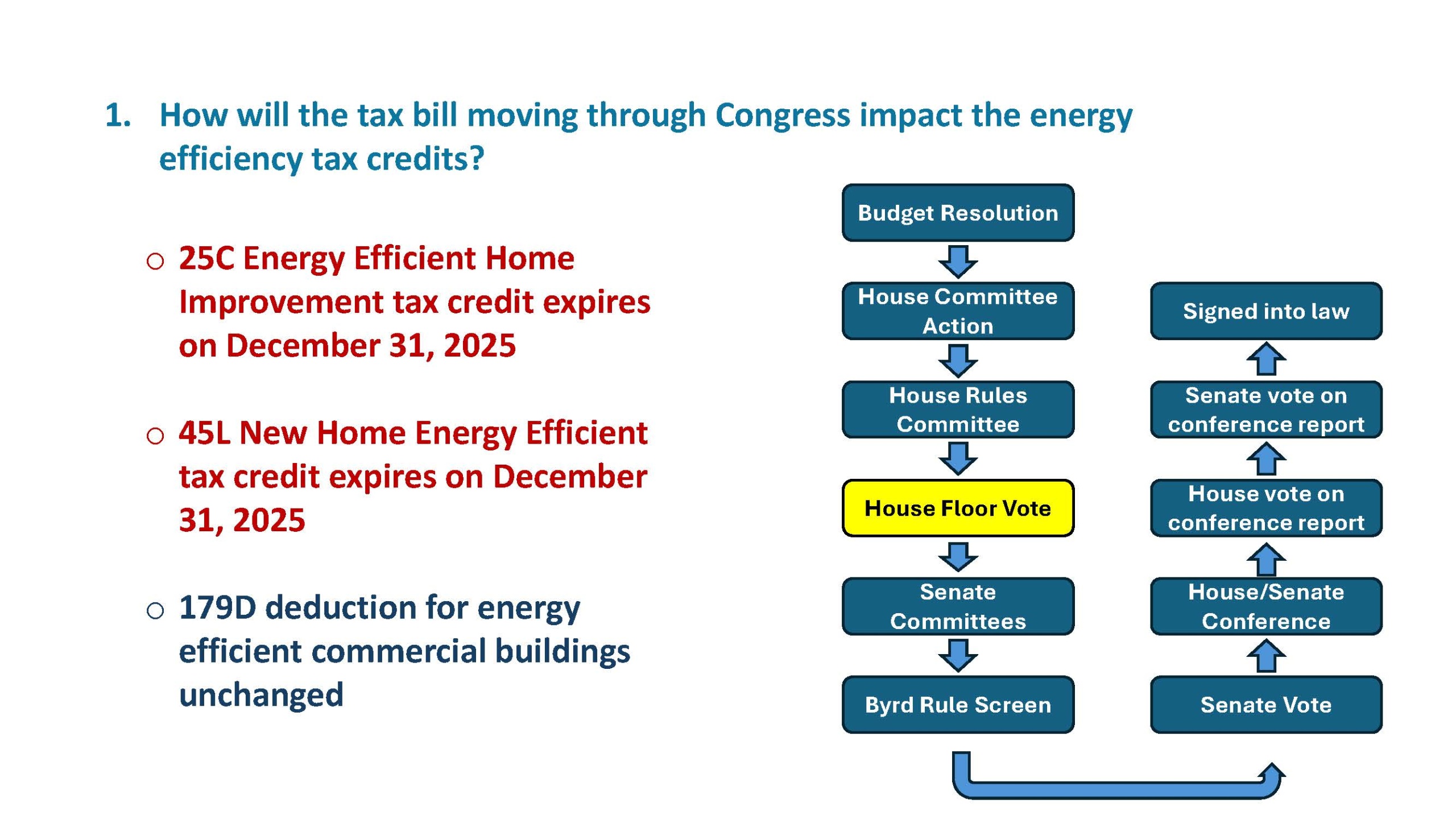
The bill will first go to the Senate Finance Committee, where Senators will likely modify the overall bill. Potential champions on that Committee for extending life of the efficiency tax credits are:
Senator Cornyn (R-Texas)
Senator Tim Scott (R-South Carolina)
Bill Cassidy (R-Louisiana)
Todd Young (R- Indiana)
Thom Tillis (R-North Carolina)
Marsha Blackburn (R-Tennessee)
Do these tax credits really matter to our industry?
The 25C tax credit provide a 30 percent tax credit up to $1,200 for insulation and air sealing materials. In 2023, 700,000 tax filers took the 25C tax credit for insulation and air sealing upgrades at an average project cost of $4,500. That means that the 25C tax credit drove more than $3 billion in business for insulation retrofit activities in 2023.
The 45L tax credit provides builders with a $2,500 to $5,000 tax credit for building highly energy efficient homes. In 2023, 350,000 homes qualified for that credit. Chances are these homes were built to above code building envelope standards given the efficiency requirements that builders must meet to qualify for the tax credit.
But I believe the insulation industry needs less government.
The simple fact is that government regulation through energy conservation, fire and building codes is the principle market driver for insulation. While much of this regulation occurs at the state and municipal level, the federal government also plays a role through both regulation and incentives to encourage highly efficient, resilient buildings. The federal role in promoting energy efficient buildings is now under attack. The following programs are threatened:
- Federal tax incentives for energy efficiency (25C and 45L) proposed for elimination
- FHA/USDA new home mortgage efficiency code requirements delayed and likely to be rescinded
- Manufactured house efficiency standards delayed and likely to be rescinded
- Inflation Reduction Act grant funding for building efficiency programs at DOE, EPA, GSA and HUD paused and likely withdrawn
- Zeroing out DOE weatherization and LIHEAP program funding to states
- Future of the DOE Building Technology Office and Energy Code Office threatened by drastic budget cuts
- Energy Star proposed for elimination
Less government is an important goal, but so is smart government. President Trump has the twin goals of energy dominance and energy affordability for Americans. Energy efficiency is the first fuel. The less you use, the further energy goes. That is important as electricity demand is forecast to increase 25 percent by 2030. Energy efficiency also translates into lower heating and cooling bills for American families.

This information was provided by Curt Rich, President and CEO of North American Insulation Manufacturers Association. Thank you, Curt, and our other insulation partners as we aim to protect our industry and provide healthier, more affordable, building science tested products to our consumers.